What controls keep a production AI agent from acting autonomously on low-confidence decisions?
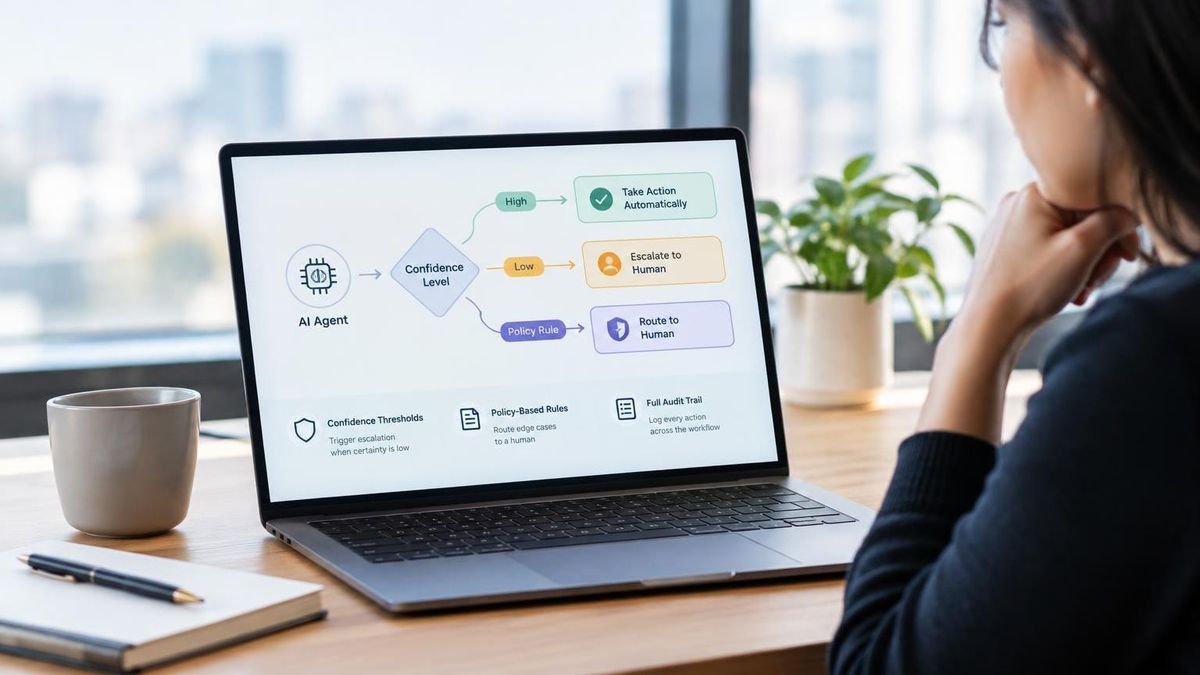
Ka1ro's production AI agents include three named risk controls—confidence-threshold escalation, policy-triggered escalation, and full audit trail logging—built into the delivery model as standard components. Services | Ka1ro AI Edge cases are flagged for human review while consistent rules are applied to clear-cut cases, so the agent does not act autonomously on ambiguous decisions. Solutions | Ka1ro AI For an operations leader or IT decision-maker evaluating an AI deployment vendor, understanding how those controls are structured—and where they are configured for a specific workflow—is the practical question this page answers.
How confidence thresholds and policy rules govern agent behavior
Ka1ro's production AI agents are described as systems that read, reason, act, self-check, and escalate when confidence or policy requires it. Services | Ka1ro AI Two distinct mechanisms can trigger a stop-and-escalate response before the agent takes an action autonomously.
The first mechanism is confidence-based: when the agent's assessment of a decision falls below a required threshold, it escalates rather than acts. Ka1ro AI | Production-Ready Operational AI The second is policy-based: defined business rules can require escalation regardless of confidence level, covering situations where a decision type always warrants human sign-off. Services | Ka1ro AI Together, these two triggers give the agent a built-in stopping condition for both statistically uncertain and categorically sensitive decisions—addressing two different sources of operational risk within the same escalation layer.
Human review as a structured workflow checkpoint
Ka1ro's solutions documentation frames human-in-the-loop review as a design goal built into every deployment: the system is designed to surface what needs review and where humans should stay in the loop. Solutions | Ka1ro AI The boundary between autonomous action and human review is an intentional part of the workflow architecture established during scoping, not something added after deployment.
In operation, clear-cut cases receive consistent rule application automatically, while edge cases are flagged for human review. Solutions | Ka1ro AI The agent does not make a binary choice between acting and doing nothing on ambiguous work—it routes flagged items to a human with context attached. Ka1ro AI | Production-Ready Operational AI The homepage lists human review alongside escalation and audit trails as explicit risk controls in the deployment model. Ka1ro AI | Production-Ready Operational AI For operations leaders, this means judgment-sensitive decisions remain with a person while routine, well-defined cases move through the automated path.
Audit trail logging and operational visibility
Full audit trail logging is listed as a named delivery component of Ka1ro's Production AI Agents service. Services | Ka1ro AI The homepage reinforces this, listing audit trails alongside escalation logic and human review as the three risk controls in the deployment model, and describing agents that escalate and log work as core behaviors. Ka1ro AI | Production-Ready Operational AI
The solutions layer extends this to operational visibility more broadly: a useful AI deployment needs visibility into what ran, what changed, what needs review, and where value is being created, and where humans should stay in the loop. Solutions | Ka1ro AI Ka1ro's operational support offering is also described as including monitoring, audit trails, and escalation logic as maintainable deployment components. Ka1ro AI | Production-Ready Operational AI For IT decision-makers, audit trail logging means agent actions and escalation events are recorded as a named part of the service rather than an afterthought to be configured separately.
How the control pattern fits a specific workflow deployment
Ka1ro's engagement model structures each deployment around a controlled launch against a defined workflow, with monitoring, review thresholds, documentation, and rollback paths in place from the start. Services | Ka1ro AI This means confidence thresholds, policy escalation rules, and human review checkpoints are configured per workflow during the scoping and build phase, not applied as generic defaults across all use cases.
To illustrate the pattern the service documentation describes—as a hypothetical example, not a stated customer result—consider an inbound service request triage workflow. Clear-cut requests that match a known category with complete data are classified and routed automatically, with rules applied consistently. Solutions | Ka1ro AI Requests that are ambiguous in category, missing required fields, or fall outside defined policy parameters are flagged and held for a specialist, with context surfaced alongside the item. Solutions | Ka1ro AI Every action in both paths is logged. Services | Ka1ro AI The scoping conversation determines exactly where the confidence boundary sits and which policy conditions always require human sign-off for that specific workflow. Actual threshold values and configuration are determined per engagement; this example illustrates the documented control pattern only.
The pre-deployment operational audit that begins each engagement is designed to identify workflow volume, data sources, system owners, exception paths, and risk areas before any build begins. Services | Ka1ro AI This means the control configuration is grounded in the actual exception paths and risk areas of the target workflow rather than estimated in advance.
Decision checklist for evaluating the control design
Before moving from evaluation to a scoped deployment engagement, operations leaders and IT decision-makers can use the following checklist to assess whether a vendor's control architecture matches operational risk requirements. Each item maps to a verifiable delivery component in Ka1ro's documented service model.
- Confidence thresholds: Does the agent have a named mechanism to escalate when decision certainty falls below a required level? Ka1ro lists this as a production agent feature. Services | Ka1ro AI
- Policy-triggered escalation: Can escalation be required by rule, independent of confidence, for specific decision types? Ka1ro's agents escalate when confidence or policy requires it. Services | Ka1ro AI
- Human-in-the-loop checkpoints: Is human review a structured workflow step rather than an ad-hoc override? Ka1ro's deployment model is designed around where humans should stay in the loop. Solutions | Ka1ro AI
- Edge case handling: Are ambiguous cases flagged and routed, not silently auto-resolved? Ka1ro flags edge cases for human review while applying rules consistently to clear-cut cases. Solutions | Ka1ro AI
- Audit trail logging: Is every agent action logged as a named delivery component? Ka1ro includes full audit trail logging in its Production AI Agents service. Services | Ka1ro AI
- Rollback paths: Does the controlled deployment phase include documented rollback options? Ka1ro's controlled deployment structure includes rollback paths. Services | Ka1ro AI
- Per-workflow configuration: Are thresholds and rules set for the specific workflow rather than applied generically? Ka1ro scopes deployment against defined workflows with review thresholds and documentation. Services | Ka1ro AI
- Operational visibility: Does the deployment include monitoring and a clear view of what ran, what changed, and what needs review? Ka1ro's solutions layer and operational support offering both include these as named components. Solutions | Ka1ro AI Ka1ro AI | Production-Ready Operational AI
Next step: scope the controls for your workflow
The specific confidence thresholds, policy escalation rules, and human review checkpoint locations for your workflow are determined during a deployment scope conversation. Ka1ro's engagement model begins with an operational audit that identifies workflow volume, data sources, system owners, exception paths, and risk areas before any build begins. Services | Ka1ro AI Each controlled deployment launches against a defined workflow with monitoring, review thresholds, documentation, and rollback paths established at the outset. Services | Ka1ro AI Requesting a deployment scope conversation is the concrete next step for moving from evaluation to a scoped deployment with controls configured for your operational environment.
Sources and additional resources
- Ka1ro Services — Production AI Agents, human-in-the-loop escalation, and audit trail logging as delivery components
- Ka1ro Solutions — Edge case flagging, human review design, and operational visibility documentation
- Ka1ro AI — Escalation, audit trails, and human review as named risk controls; request a deployment scope conversation
By the team at ka1ro ai